QuartzJohor · Countertop Guide
Which Kitchen Countertop Should You Choose?
It’s the oldest argument in kitchen renovation: quartz vs granite. One’s engineered, one’s natural, both look fantastic in a showroom — and the wrong choice means living with stains, sealing chores, or scorch marks for the next decade. So let’s settle it for a Johor kitchen specifically, where humidity, heavy cooking and a heating-up property market all factor in.
There’s a fresh angle worth knowing too. With the RTS Link targeted to open end-2026 and the Johor-Singapore Special Economic Zone lifting home values across the Tebrau and Iskandar corridors, the resale durability of your countertop matters more than it used to. And the recent global scrutiny of high-silica engineered stone has put natural granite back in the conversation. Here’s the straight version, no brand bias.
Want a recommendation for your exact kitchen? Ask us via our contact page and we’ll point you to the right surface.
Planning cabinets too? WhatsApp us about kitchen cabinets →Quartz vs granite: the honest difference
Start with what they actually are, because it drives everything else.
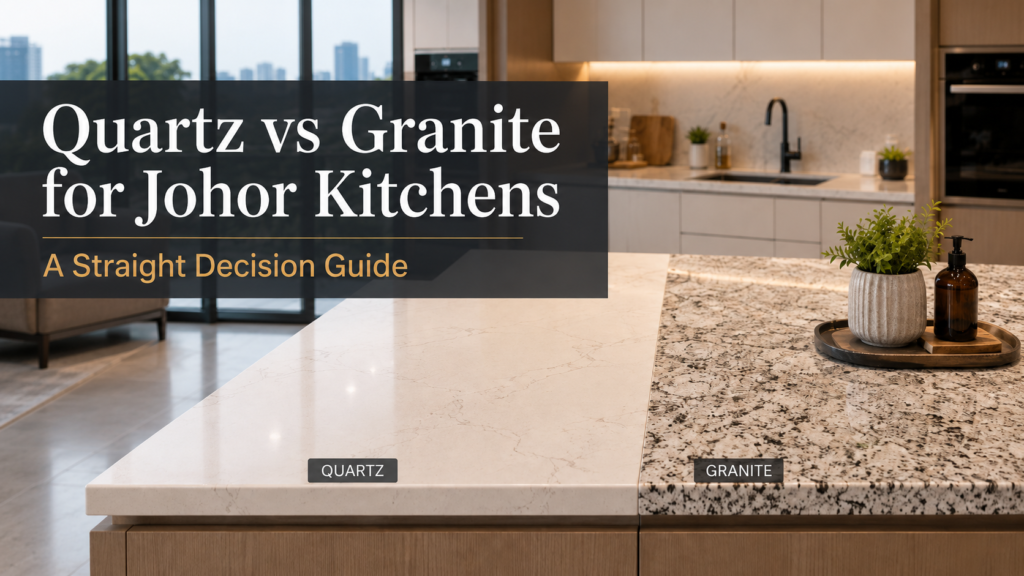
Granite is 100% natural stone, quarried and cut into slabs. Every piece is unique, with natural movement and depth no factory can copy. It contains crystalline silica naturally — typically under 45%, much less than engineered quartz.
Quartz is engineered, or “man made counter tops” as people often search — crushed natural quartz bound with resin and pigment into a uniform, non-porous slab. Consistent pattern, wide colour range, no sealing needed.
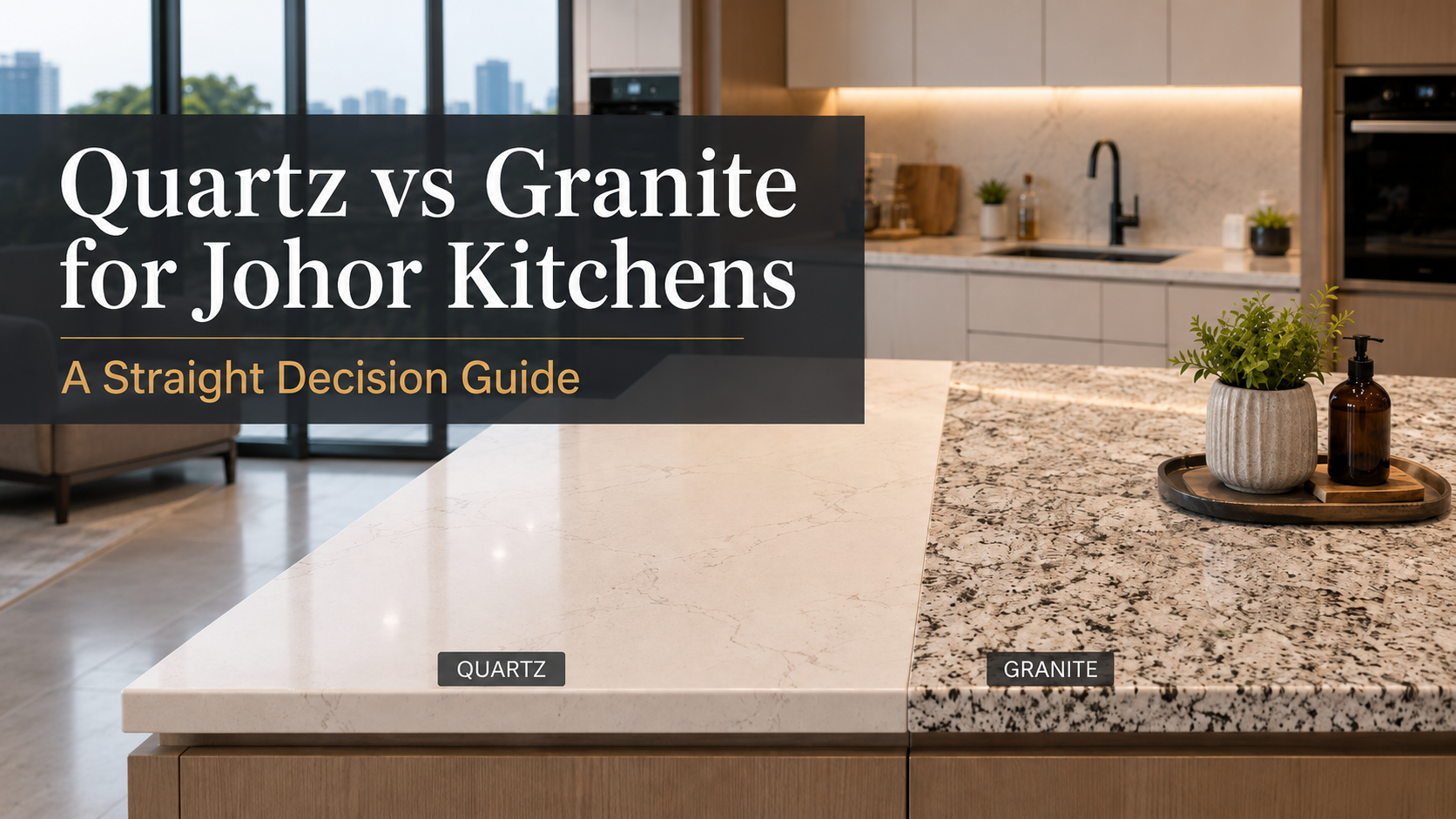
So the core trade-off is character vs consistency, and natural vs engineered. Neither is “better” outright; they’re better at different things. Our kitchen countertop materials guide lays out where each fits.
Maintenance: which is easier in Johor’s humidity?
This is where many JB homeowners decide. Our climate is hot and humid year-round, and that’s hard on porous surfaces.
Quartz is non-porous, so it never needs sealing. Spills like soy sauce, turmeric and coffee sit on top and wipe away — genuinely low-maintenance, which is why it dominates dry kitchens and busy households.
Granite is porous and needs periodic sealing to resist stains and bacteria. Skip the sealing and a humid Johor kitchen will eventually mark it. It’s not high-drama, but it is a recurring chore quartz simply doesn’t have.
If “set and forget” is your priority, quartz wins maintenance. If you’ll happily reseal once in a while for natural beauty, granite is very liveable.
Not sure you’ll keep up with sealing? Tell us your habits via our contact page and we’ll point you to the lower-effort surface.
Heat, scratches and stains: how quartz and granite hold up
Daily kitchen abuse separates the two:
- Heat: Granite wins. As natural stone, it tolerates direct heat better than resin-bound quartz, which can scorch under prolonged high heat. If you regularly move pots straight from flame to counter, granite (or sintered stone) is more forgiving.
- Scratches: Both are hard and scratch-resistant; granite is slightly more prone to chipping at edges, quartz to surface scorching. Use a board for both.
- Stains: Quartz wins, thanks to its non-porous surface. Unsealed granite can absorb oil and coloured liquids.
If heat resistance is your top concern but you want quartz-like low maintenance, sintered stone is the surface that gives you both — see our sintered stone explainer.
Sensa by Cosentino: the granite that behaves like quartz
Here’s a middle path many people don’t know about. Sensa by Cosentino is natural granite that’s been factory-treated with a protective, stain-resistant coating — giving you real granite character with low-maintenance, near-quartz upkeep, backed by a long manufacturer warranty.
So if you love granite’s natural movement but dread the sealing chore, Sensa is the bridge: natural stone, protected surface, and that warranty for peace of mind. Our Sensa granite page covers the local range and what the warranty actually includes. For brand-versus-natural comparisons, our Caesarstone vs granite breakdown is the deeper read.
Interested in protected granite? Ask us about Sensa and its warranty via our contact page — we’ll explain the coverage in plain terms.
Cost and resale: quartz vs granite value in a JB kitchen
Budget rarely splits cleanly here — both span a wide range depending on grade and slab. Premium branded quartz (like Silestone) and exotic granite both sit at the top; mid-range options of each are comparable.
What’s changed is the resale lens. With JB property demand rising ahead of the RTS Link and JS-SEZ, a durable, well-finished kitchen is a genuine selling point. Buyers crossing from Singapore expect move-in-ready quality. A low-maintenance quartz or a protected granite like Sensa both read as “premium and cared for” — the kind of detail that helps a unit stand out in a busier market.
The honest guidance: pick the surface you’ll actually maintain. A neglected granite ages worse than a well-chosen quartz, and vice versa.
Get a quote on both quartz and granite via our contact page and compare the real numbers for your kitchen.
Quartz or granite for your kitchen — see both in JB
Specs only get you so far. Granite’s natural movement and quartz’s engineered consistency look completely different in person, and your kitchen’s lighting will change how each reads. The decision usually makes itself the moment you see the actual slabs side by side.
We keep quartz, protected granite like Sensa, and sintered stone on display at our Johor Bahru showroom. Bring your floor plan, tell us how you cook and how much maintenance you’ll tolerate, and we’ll point you to the right surface and quote it in one visit.
See quartz and granite together. Book a viewing or countertop quote via our contact page.
Doing the whole kitchen? WhatsApp us about kitchen cabinets →FAQ: Quartz vs granite
Is granite or quartz better for a kitchen?
Quartz is better for low maintenance and stain resistance because it’s non-porous and never needs sealing, while granite is better for heat tolerance and natural, one-of-a-kind character. The right choice depends on your cooking habits and how much upkeep you’ll accept.
Does quartz or granite need sealing?
Granite is porous and needs periodic sealing to resist stains, especially in a humid climate, while quartz is non-porous and never needs sealing. This makes quartz the lower-maintenance option for busy kitchens.
Which is more heat resistant, quartz or granite?
Granite tolerates direct heat better than quartz, which is resin-bound and can scorch under prolonged high heat. For maximum heat resistance with low maintenance, sintered stone outperforms both.
What is Sensa granite and does it have a warranty?
Sensa by Cosentino is natural granite treated with a protective, stain-resistant coating, giving real granite looks with low-maintenance upkeep. It comes with a long manufacturer warranty; confirm the exact coverage and terms for the current range before purchase.
Are quartz countertops the same as man-made countertops?
Yes — quartz countertops are a type of man-made or engineered surface, created by binding crushed natural quartz with resin and pigment. This differs from granite, which is 100% natural stone cut directly from quarried slabs.
Which adds more resale value in Johor, quartz or granite?
Both add value when well-chosen and well-maintained; what matters most is a durable, move-in-ready finish that appeals to buyers. As JB property demand rises ahead of the RTS Link, a low-maintenance quartz or a protected granite like Sensa both signal a premium, cared-for kitchen.
QuartzJohor — quartz & sintered stone countertops by AmpQuartz, Johor Bahru. Quartz countertop enquiries via the contact page; full kitchen cabinet & renovation via WhatsApp.
Sign Up For Kitchen Design Ideas
Join over 5,000 homeowners subscribed to our newsletter!